
Ultimate Lift / Barbell Strength / Intermediate
Barbell
Strength Builder.
A nine-week intermediate barbell-strength block for the squat, bench press, deadlift and overhead press. Build, Progress and Heavy cycles combine dedicated lift days with assistance for the main lifts.
Look inside the first weekThe structure
Build. Progress. Heavy.
Three cycles of three weeks. The four main lifts repeat while the working weights and rep targets change.
Programme requirements
Who this programme suits.
Barbell Strength Builder is intended for intermediate lifters who train the four main barbell lifts confidently. It requires four sessions each week, including preparation, main lifts, pulling and assistance.
Experience
Intermediate barbell training, typically a year or more of consistent practice. Confidence with the lifts matters more than time alone.
Starting point
A recent, credible estimated 1RM for each main lift, a conservative training max and familiarity with effort-based loading.
The four main lifts
Low-bar back squat, flat barbell bench press, conventional deadlift and standing barbell overhead press.
Weekly commitment
Squat Day, Bench Day, Deadlift Day and Press Day. Sessions are estimated at 60–75 minutes; days can be scheduled across the week.
Nine weeks / Three cycles
Nine-week loading progression.
Build, Progress and Heavy each move from sets of five to triples to a heavier week. The corresponding target increases in the next cycle. Main-lift percentages use a training max of approximately 90% of estimated 1RM.
The table shows the working sets for all four main lifts. Ramp sets come first. Main-lift rest is three minutes in fives and triples weeks, and four minutes in heavy weeks.
| Cycle | Week | Working sets | Top set |
|---|---|---|---|
| Build | 1 | 2 × 5 at 65% | 1 × 5 at 70% |
| Build | 2 | 2 × 3 at 70% | 1 × 3 at 75% |
| Build | 3 | 2 × 3 at 72.5% | 1 × 2+ at 80% |
| Progress | 4 | 2 × 5 at 67.5% | 1 × 5 at 72.5% |
| Progress | 5 | 2 × 3 at 75% | 1 × 3 at 80% |
| Progress | 6 | 2 × 3 at 77.5% | 1 × 2+ at 85% |
| Heavy | 7 | 2 × 5 at 70% | 1 × 5 at 75% |
| Heavy | 8 | 2 × 3 at 77.5% | 1 × 3 at 82.5% |
| Heavy | 9 | 2 × 3 at 82.5% | 1 × 2+ at 90% |
2+ means a controlled double with an extra rep or two only while bar speed stays sharp. Stop before grinding or failure. The programme has no separate deload week.
Week 1 session structure
Four sessions and four main lifts.
Each session combines preparation and ramp sets with a main lift, secondary lift, pulling and paired assistance.
Week 1 · About 70 minutes
Squat Day
Low-bar back squat: ramp sets of 5 at 45% and 3 at 57.5% of training max. Then 2 × 5 at 65% and 1 × 5 at 70%, with three-minute rests between working sets.
| Role | Movement | Work |
|---|---|---|
| Secondary lift | 45-degree leg press | 3 × 6–8 · RPE 7 |
| Pulling | Bent-over barbell row | 4 × 8 · RPE 7 |
| Assistance A | Seated leg curl | 2 × 10 · RPE 6.5 |
| Assistance B | Forearm plank | 2 × 40 seconds |
Assistance A and B form a two-round pairing: one set of each movement per round. Rest 30 seconds between movements and 75 seconds between rounds. Secondary-lift rests are 150 seconds; pulling rests are 90 seconds.
Week 1 · About 65 minutes
Bench Day
Flat barbell bench press: ramp sets of 5 at 45% and 3 at 57.5% of training max. Then 2 × 5 at 65% and 1 × 5 at 70%, with three-minute rests between working sets.
| Role | Movement | Work |
|---|---|---|
| Secondary lift | Close-grip bench press | 3 × 6 · RPE 7 |
| Pulling | Seated cable row | 4 × 10 · RPE 7 |
| Assistance A | Rope face pull | 2 × 15 · RPE 6.5 |
| Assistance B | Rope triceps pushdown | 2 × 12 · RPE 6.5 |
Assistance A and B form a two-round pairing: one set of each movement per round. Rest 30 seconds between movements and 75 seconds between rounds. Secondary-lift rests are 150 seconds; pulling rests are 90 seconds.
Week 1 · About 70 minutes
Deadlift Day
Conventional barbell deadlift: ramp sets of 5 at 45% and 3 at 57.5% of training max. Then 2 × 5 at 65% and 1 × 5 at 70%, with three-minute rests between working sets.
| Role | Movement | Work |
|---|---|---|
| Secondary lift | Romanian deadlift | 3 × 6 · RPE 7 |
| Pulling | Wide-grip lat pulldown | 3 × 10 · RPE 7 |
| Assistance A | Bodyweight back extension | 2 × 12 · RPE 6.5 |
| Assistance B | Dead bug | 2 × 8 each side |
Assistance A and B form a two-round pairing: one set of each movement per round. Rest 30 seconds between movements and 75 seconds between rounds. Secondary-lift rests are 150 seconds; pulling rests are 90 seconds.
Week 1 · About 65 minutes
Press Day
Standing barbell overhead press: ramp sets of 5 at 45% and 3 at 57.5% of training max. Then 2 × 5 at 65% and 1 × 5 at 70%, with three-minute rests between working sets.
| Role | Movement | Work |
|---|---|---|
| Secondary lift | Incline dumbbell press | 3 × 8 · RPE 7 |
| Pulling | Pull-up | 3 × 5–8 · RPE 7 |
| Assistance A | Dumbbell curl | 2 × 10 · RPE 6.5 |
| Assistance B | Hanging leg raise | 2 × 10 |
Assistance A and B form a two-round pairing: one set of each movement per round. Rest 30 seconds between movements and 75 seconds between rounds. Secondary-lift rests are 150 seconds; pulling rests are 90 seconds.
The full sessions include preparation and a brief cool-down. For example, Squat Day begins with cat-cow, bodyweight squats and glute bridges, and finishes with hip-flexor and hamstring stretches.
Programme continuation
Review all three cycles.
The Progress view compares the planned intensity with the sessions you completed, with a workload line across all nine weeks.
Use it during the programme to follow your progress, or return after the final week to review each cycle. This example shows a completed programme with sample training.
Review your programme progress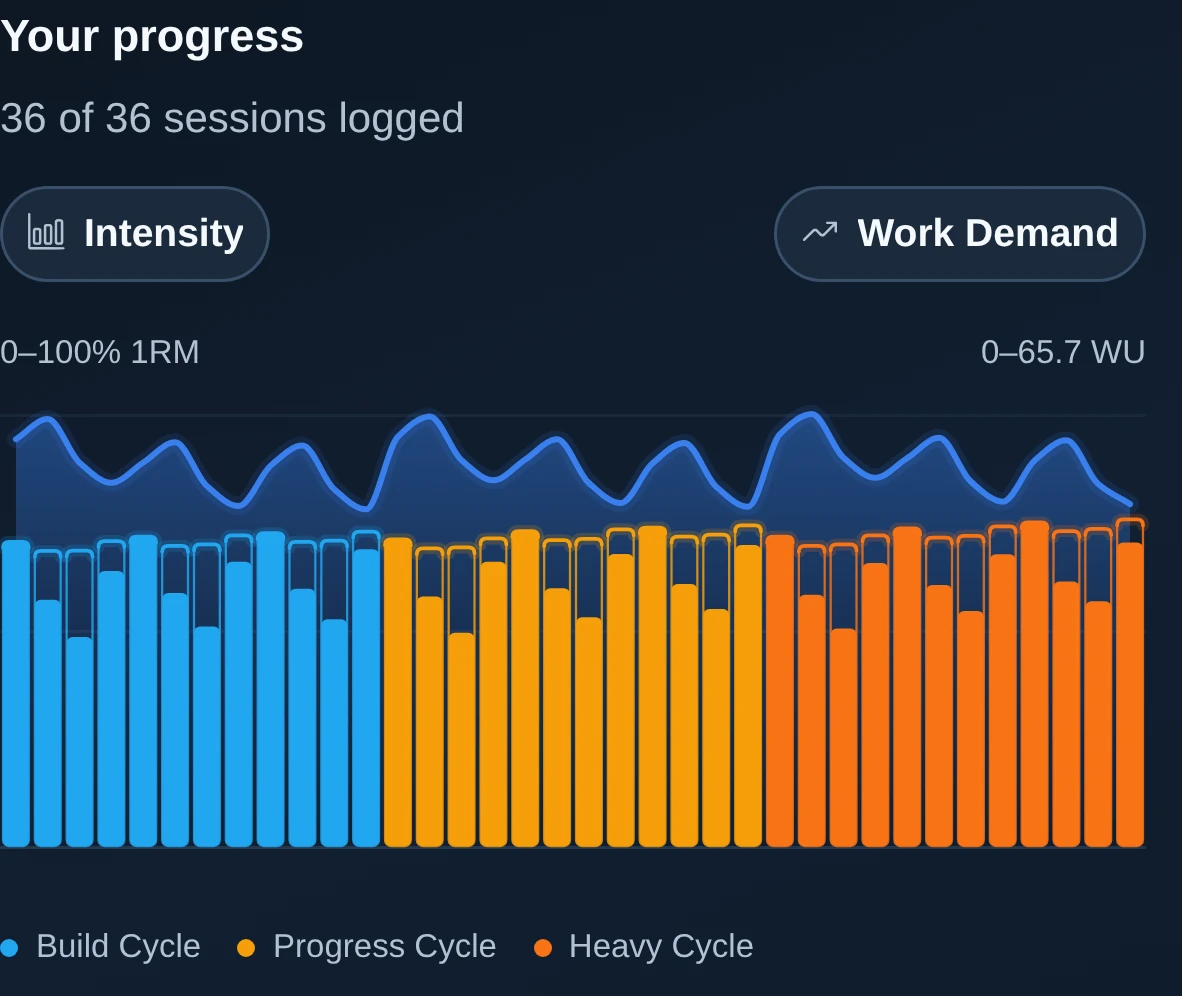
Equipment requirements
Full-gym equipment and loading methods.
This is a full-gym programme. Alongside a barbell, plates and rack, you need a flat and incline bench, dumbbells, a cable station with row, pulldown and rope attachments, a 45-degree leg press, seated leg curl and a pull-up or hanging station.
Main-lift ramp and working sets use training-max percentages. Secondary compounds and pulling generally use RPE 7, with loaded assistance generally at RPE 6.5. Follow the instructions for each movement rather than applying one loading rule to the whole session.
Complete session and equipment requirements are available before enrolment. When an alternative movement is selected, the original programme intent remains available for later review.
Programme development
Why the programme is built this way.
Barbell Strength Builder follows a documented design brief using established loading, progression and session-design principles. Its development uses AI-assisted authoring and human review of the audience, structure, effort, recoverability, equipment and movement guidance.
The programme's rationale is visible in the sessions: conservative main-lift reference loads, changing repetition demands, progressively heavier corresponding cycles and assistance that supports the main lifts.
It sits within Ultimate Lift's Barbell Strength pathway, between Barbell Strength Foundations and Strength Intensification. Programme selection depends on current training demands; completion does not automatically indicate progression to the next programme.
Back to programmes